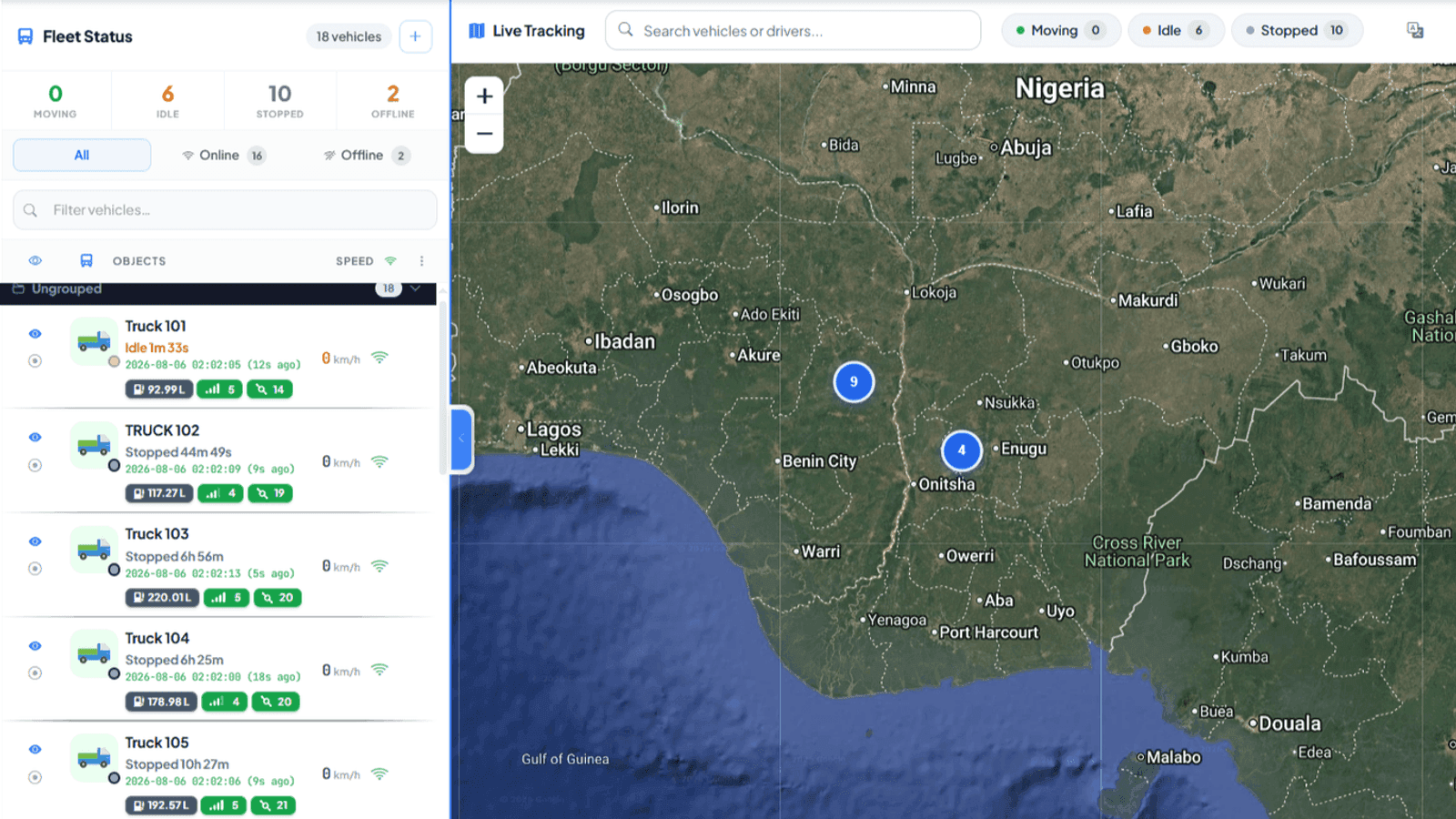
A fleet manager opens his phone.
The truck was supposed to be in Benin.
The map says it is still in the same place it was two hours ago.
He calls the driver.
The driver says the truck is moving.
The tracker says otherwise.
Then the familiar explanation arrives:
"Network problem."
Maybe it is.
Maybe it isn't.
That is the problem.
The company has paid for a tracking system, but when the system matters most, nobody is completely sure what the device knows, what it has recorded or what happened during the period when it stopped communicating.
This is the uncomfortable truth about much of Nigeria's GPS tracking market:
The cheapest tracker can be the most expensive tracker you ever buy.
Not because every inexpensive device is bad.
And not because every expensive device is good.
But because a GPS tracker is not simply a small box with a SIM card inside it.
It is a piece of equipment that is expected to protect, monitor and report on an asset that may be worth tens or hundreds of millions of naira.
The hardware therefore deserves more scrutiny than its price tag usually receives.
"But it has GPS"
That is often where the conversation ends.
A customer asks for a tracker.
The supplier shows a device.
"It has GPS."
"It has an app."
"It has live tracking."
"It has a SIM."
"How much?"
The cheaper quotation wins.
But saying two trackers both have GPS tells you very little.
A modern professional tracker can contain a GNSS receiver, cellular modem, processor, internal memory, accelerometer, backup battery, multiple inputs and outputs, Bluetooth connectivity, CAN interfaces, firmware-update capability and protection against electrical problems.
A basic generic tracker may have some of those things.
The question is which ones.
And more importantly:
How well do they work?
Look at the difference in the hardware
Take Teltonika's FMC920 as an example.
It is not an exotic piece of equipment. It is a relatively compact tracker designed for basic fleet and vehicle applications.
But look beneath the plastic.
The FMC920 supports LTE Cat 1 and GSM, has a high-gain GNSS receiver, a high-gain cellular antenna, 128 MB of internal flash memory capable of storing up to 422,400 records, an integrated backup battery, an accelerometer, Bluetooth connectivity, a digital input, digital output and analogue input. It also supports functions including excessive-idling detection, towing detection, crash detection, jamming detection and offline tracking.
That last feature matters.
Offline tracking.
The truck does not have to remain connected every second for the journey to remain useful.
If cellular communication disappears, the device can retain records and transmit them later when communication returns.
That is very different from a device that simply stops reporting and leaves the fleet manager staring at its last known location.
Then there is the FMC650
Now consider a professional heavy-duty tracker such as Teltonika's FMC650.
This is where the difference between "GPS tracker" and "fleet telematics equipment" becomes much clearer.
The FMC650 supports 4G LTE Cat 1 with 2G fallback, external high-gain GNSS and cellular antennas, dual SIM or eSIM, internal memory and external MicroSD storage.
But the interesting part is what it can connect to.
The device supports CAN J1939, J1708, K-Line, RS232 and RS485 interfaces, alongside multiple digital and analogue inputs and outputs. Teltonika specifically positions it for applications including international logistics, refrigerated transport, agriculture, construction and mining.
Side by side, the difference is not a matter of one being "better". It is a matter of what each device is built to do:
| FMC920 | FMC650 | |
|---|---|---|
| Positioned for | Basic fleet and vehicle applications | Heavy-duty: logistics, refrigerated transport, agriculture, construction, mining |
| Cellular | LTE Cat 1 and GSM | 4G LTE Cat 1 with 2G fallback |
| Antennas | High-gain GNSS and cellular | External high-gain GNSS and cellular |
| SIM | Not specified | Dual SIM or eSIM |
| Storage | 128 MB internal flash, up to 422,400 records | Internal flash plus external MicroSD, up to 32 GB |
| Vehicle interfaces | 1 digital in, 1 digital out, 1 analogue in, Bluetooth | CAN J1939, J1708, K-Line, RS232, RS485, plus multiple digital and analogue I/O |
| Notable functions | Excessive-idling, towing, crash and jamming detection, offline tracking, accelerometer, backup battery | FMS CAN/J1939 and J1708 fuel data, overvoltage and reverse-polarity protection, offline tracking |
This table summarises only the specifications cited in this article. Teltonika's own documentation, linked at the end, carries the complete list.
That means the device can move beyond simply answering:
"Where is the truck?"
It can help answer questions such as:
What is the truck doing?
What is the engine reporting?
What is the fuel system reporting?
What is the vehicle's operating behaviour?
What data is available from the vehicle's CAN bus?
That is a completely different proposition.
J1939 is not a marketing word
For heavy-duty fleets, this matters.
J1939 is used extensively for communication between electronic control units in heavy vehicles.
A professional telematics device that can read J1939 data can potentially access information that a simple GPS tracker cannot.
The FMC650, for example, supports FMS CAN/J1939 data and J1708, and Teltonika documents J1708 functionality for obtaining fuel-level and fuel-consumption information where supported by the vehicle.
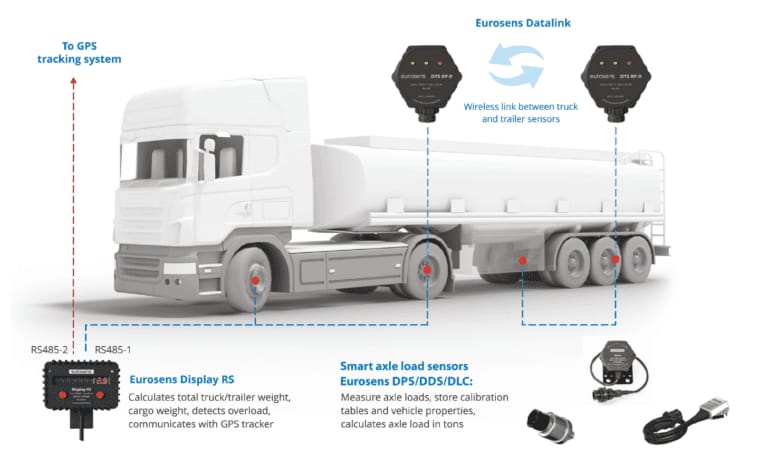
That matters for the Nigerian fleet operator running trucks, trailers, construction equipment and other heavy assets.
You are no longer simply buying a device that says:
"Your truck is here."
You are buying a device capable of becoming part of the vehicle's information system.
That is the difference between tracking and telematics.
The blind spot nobody talks about
Every fleet manager understands the frustration.
A vehicle is moving.
Then the map stops.
The driver is still driving, but the screen has not changed.
What happens next depends heavily on the device.
A tracker cannot create a cellular network where none exists.
That needs to be said clearly.
If there is genuinely no cellular service, a conventional cellular tracker cannot send live information to the server.
But that does not mean the device should forget the journey.
A properly designed tracker can continue collecting location data and store it locally.
When connectivity returns, the stored information can be transmitted.
Teltonika's FMC920 and FMC650 both support offline tracking, and the FMC920's published specifications show substantial internal storage.
This is a small technical feature with a large practical consequence.
The difference is between:
"We lost the vehicle for two hours."
and:
"We temporarily lost live communication, but the complete journey was recorded and recovered."
Those are not the same thing.
Memory matters more than most buyers realise
Ask a supplier:
"How much internal memory does the tracker have?"
You may be surprised by the answer.
Many buyers have never asked.
They are more interested in the size of the application, the colour of the map or whether the system has a mobile app.
But memory matters because the tracker needs somewhere to put information when communication is unavailable.
Teltonika's FMC920, for example, has 128 MB of internal flash memory and is specified to store up to 422,400 records.
The FMC650 uses a different architecture, with internal flash and an external MicroSD card slot capable of supporting up to 32 GB.
That is the sort of engineering detail most buyers never see on a quotation.
And it is precisely the kind of detail that matters when the vehicle is hundreds of kilometres away from your office.
The Nigerian market has a price problem
Nigeria's GPS tracking market has become crowded.
There are established telematics brands.
There are regional manufacturers.
There are white-label devices.
There are generic devices sold under different names.
There are devices that look almost identical but contain very different components.
And there are installers who will tell a customer:
"This one does the same thing."
Sometimes it does.
Sometimes it doesn't.
The difficulty for the buyer is knowing the difference.
A generic tracker can look convincing in a demonstration because almost every tracker can produce a moving dot on Google Maps.
The real test comes later.
After installation.
After months of vibration.
After electrical fluctuations.
After repeated trips.
After firmware changes.
After network problems.
After the vehicle leaves the city.
After the customer actually depends on the data.
Why does Nigeria get flooded with cheap devices?
There is no single answer.
Global electronics manufacturing produces enormous quantities of low-cost hardware. Some products are designed specifically for cost-sensitive markets. Others are white-labelled and sold under different brands. Some are older-generation devices that remain commercially viable in certain markets.
The problem is not simply where a device was manufactured.
China, for example, produces both sophisticated industrial technology and very cheap consumer electronics.
The country of manufacture does not tell you whether a specific tracker is good.
The questions are:
- Who designed it?
- What modem does it use?
- What GNSS receiver does it use?
- How much memory does it have?
- What cellular bands does it support?
- What protections does it have?
- What happens when the network disappears?
- Does the manufacturer provide firmware updates?
- Who supports the device after installation?
- Is the specific model properly approved for the market where it will operate?
Those questions are much more useful than asking where the box was manufactured.
"It works abroad" is not enough
Another weak argument in the market is:
"They use this device abroad."
That does not prove anything.
A device may be perfectly suitable for one country's network environment and unsuitable for another.
Cellular bands differ.
Carrier technologies differ.
Regulations differ.
Environmental conditions differ.
Server infrastructure differs.
Support arrangements differ.
A device designed for one market may work perfectly well somewhere else, but compatibility should be established from the actual specifications rather than assumed.
The Nigerian Communications Commission maintains a type-approval process for communications equipment, and its regulations exist precisely because telecommunications equipment placed on Nigerian networks cannot simply be treated as generic electronic boxes. Approved equipment can be checked through the NCC type-approval portal.
For a serious fleet operator, asking whether the exact model is approved and supported for the intended deployment is basic due diligence.
The device can be cheap because the engineering is cheap
This is the uncomfortable part.
Sometimes a cheap device is cheap because the manufacturer has found an efficient way to manufacture it.
That's fine.
But sometimes it is cheap because something has been removed.
Perhaps the modem is lower specification.
Perhaps the memory is smaller.
Perhaps there is no meaningful backup battery.
Perhaps the antenna is mediocre.
Perhaps the firmware is poorly maintained.
Perhaps there is limited protection against voltage spikes.
Perhaps there is no meaningful after-sales support.
Perhaps the manufacturer does not even have a long-term interest in the product.
The buyer sees ₦30,000.
The manufacturer sees a cost structure.
The fleet manager sees a tracker.
But the business ultimately experiences the consequences of everything that was left out.
Heavy vehicles are not friendly places for electronics
A fleet tracker lives in an environment that is far less comfortable than the office where its performance is demonstrated.

It experiences vibration.
Heat.
Cold starts.
Voltage fluctuations.
Electrical interference.
Dust.
Moisture.
Repeated ignition cycles.
Long operating hours.
And, depending on installation, poor physical positioning.
Professional hardware is designed around those realities.
Teltonika's FMC650, for example, includes overvoltage and reverse-polarity protection and is specified for heavy-duty applications.
That doesn't make it indestructible.
Nothing is.
But it shows the difference in design philosophy.
The question isn't:
"Does the tracker turn on?"
The question is:
"Was the tracker engineered for the environment in which I'm putting it?"
What happens when you save ₦30,000 on 100 vehicles?
Let's make the calculation simple.
A company has 100 vehicles.
It saves ₦30,000 per vehicle by choosing cheaper hardware.
That is:
₦3 million saved.
It looks good on the procurement report.
Now suppose the cheaper system creates problems.
Five vehicles experience recurring hardware failures.
Several vehicles lose historical data.
Technicians return to installations.
Drivers spend time troubleshooting devices.
Management loses confidence in the data.
Fuel anomalies are missed.
A vehicle operates outside its expected route.
Maintenance information is incomplete.
The company eventually begins replacing devices.
The ₦3 million saving is no longer the whole story.
This is why serious procurement should calculate total cost of ownership, not simply purchase price.
The cheapest tracker may be the most expensive device in the fleet
There is a simple way to understand this.
A tracker costs money to buy.
A failed tracker costs money to replace.
An unreliable tracker costs money in uncertainty.
A tracker that loses data costs money in lost visibility.
A poorly supported tracker costs money in technician visits.
A device that cannot integrate with the rest of the fleet costs money in manual work.
And a system that management does not trust eventually becomes useless, regardless of how cheap it was.
That is the trap.
The cost of hardware is measurable. The cost of unreliable information is not.
The real product isn't the tracker
This is where Primera Automations takes a different position.
We don't believe the product is the small black box hidden beneath the dashboard.
That is only one component.
The real product is the management capability built around it.
The device collects information.
The server receives it.
The platform organises it.
The fleet manager interprets it.
The business acts on it.
Maintenance follows.
Drivers are held accountable.
Fuel anomalies are investigated.
Routes are reviewed.
Operational decisions improve.
That is fleet management.
Installing a tracker is relatively easy.
Building a system that a business can rely on is the harder job.
Why Primera does not treat every fleet the same
A company operating five cars around Lagos does not have the same requirements as a company operating 40 heavy trucks across Nigeria.
A construction company does not have the same requirements as a courier company.
A mining operation does not have the same requirements as a passenger transport company.
A fuel bowser does not have the same risk profile as a sales representative's vehicle.
So why should they all receive the same tracker?
They shouldn't.
The right approach begins with the operation.
What type of vehicle?
What environment?
What distance?
What network conditions?
What information does management actually need?
Is fuel monitoring required?
Is CAN data required?
Is driver behaviour important?
Does the vehicle require immobilisation?
Does the customer need additional sensors?
Does the application require long-term historical data?
Once those questions are answered, the hardware can be selected appropriately.
That is what professional fleet management should look like.
The difference between a tracker seller and a fleet management partner
A tracker seller asks:
"How many devices do you want?"
A fleet-management partner asks:
"What problem are you trying to solve?"
The first conversation starts with hardware.
The second starts with the business.
That distinction matters.
Because if the customer's problem is fuel loss, simply installing GPS does not solve it.
If the problem is driver behaviour, location alone may not be enough.
If the problem is heavy-truck performance, the ability to access CAN/J1939 data may be far more valuable.
If the problem is maintenance, vehicle data and maintenance workflows matter.
If the problem is theft, tracking, geofencing, alerts and recovery procedures matter.
The device should follow the requirement.
Not the other way around.
The future of fleet management is not a cheaper tracker
The Nigerian market will continue to have cheap devices.
There will always be someone willing to sell a tracker for less.
There will always be a customer asking:
"Why is yours more expensive?"
That question is fair.
The answer should not be:
"Because ours is better."
The answer should be:
"Here is exactly what you are getting for the difference."
More reliable communication.
Better data retention.
Better vehicle integration.
Better protection.
Better diagnostics.
Better support.
Better software.
Better maintenance.
Better accountability.
Better visibility.
And, ultimately, better control of an asset that may be worth many times more than the tracking equipment attached to it.
Don't buy the cheapest tracker. Buy the right system.
There is nothing wrong with saving money.
There is something wrong with saving money on the component responsible for giving you visibility over a multimillion-naira asset without first understanding what you are sacrificing.
A tracker is cheap compared with a truck.
It is cheap compared with a stolen vehicle.
It is cheap compared with weeks of unnecessary downtime.
It is cheap compared with years of uncontrolled fuel losses.
And it is certainly cheap compared with the cost of making major business decisions using bad information.
The real question isn't:
"How much does the tracker cost?"
It is:
"How much is my fleet worth, and how much am I willing to risk because I wanted the cheapest tracking device?"
At Primera, the installation is only the beginning
At Primera Automations, we don't see fleet tracking as a hardware installation business.
The tracker is a tool.
The data is the raw material.
The management system is what creates the value.
Our job is to help businesses understand what their vehicles are doing, where their money is going, when their assets need attention and where operational problems are developing.
Sometimes that means a basic tracker is exactly what the customer needs.
Sometimes it means a more advanced device.
For a heavy-duty fleet, that may mean CAN/J1939 integration, fuel monitoring or other telematics equipment.
The point is not to sell the most expensive device.
The point is to deploy the right technology for the job and then actually manage the information it produces.
Because putting a tracker in a truck is not fleet management.
Knowing what to do with the information after the truck leaves your yard is.
And when a business has millions of naira sitting on wheels, that distinction matters.
About Primera Automations Ltd
Primera Automations Ltd provides fleet-management, telematics, GPS tracking, fuel monitoring and vehicle-monitoring solutions for businesses operating commercial and industrial fleets.
Our approach goes beyond installing hardware.
We help businesses choose the appropriate technology, deploy it correctly and turn vehicle data into information that management can actually use.
Because a tracker tells you where the vehicle is. A proper fleet-management system helps you understand what the vehicle is doing. Talk to us.
Technical references
- Teltonika, FMC920 specifications and features
- Teltonika, FMC920 technical documentation
- Teltonika, FMC650 product information
- Teltonika, FMC650 technical documentation
- Teltonika, FMC650 J1708 and fuel data documentation
- Nigerian Communications Commission, Type Approval portal
- Nigerian Communications Commission, Type Approval information