

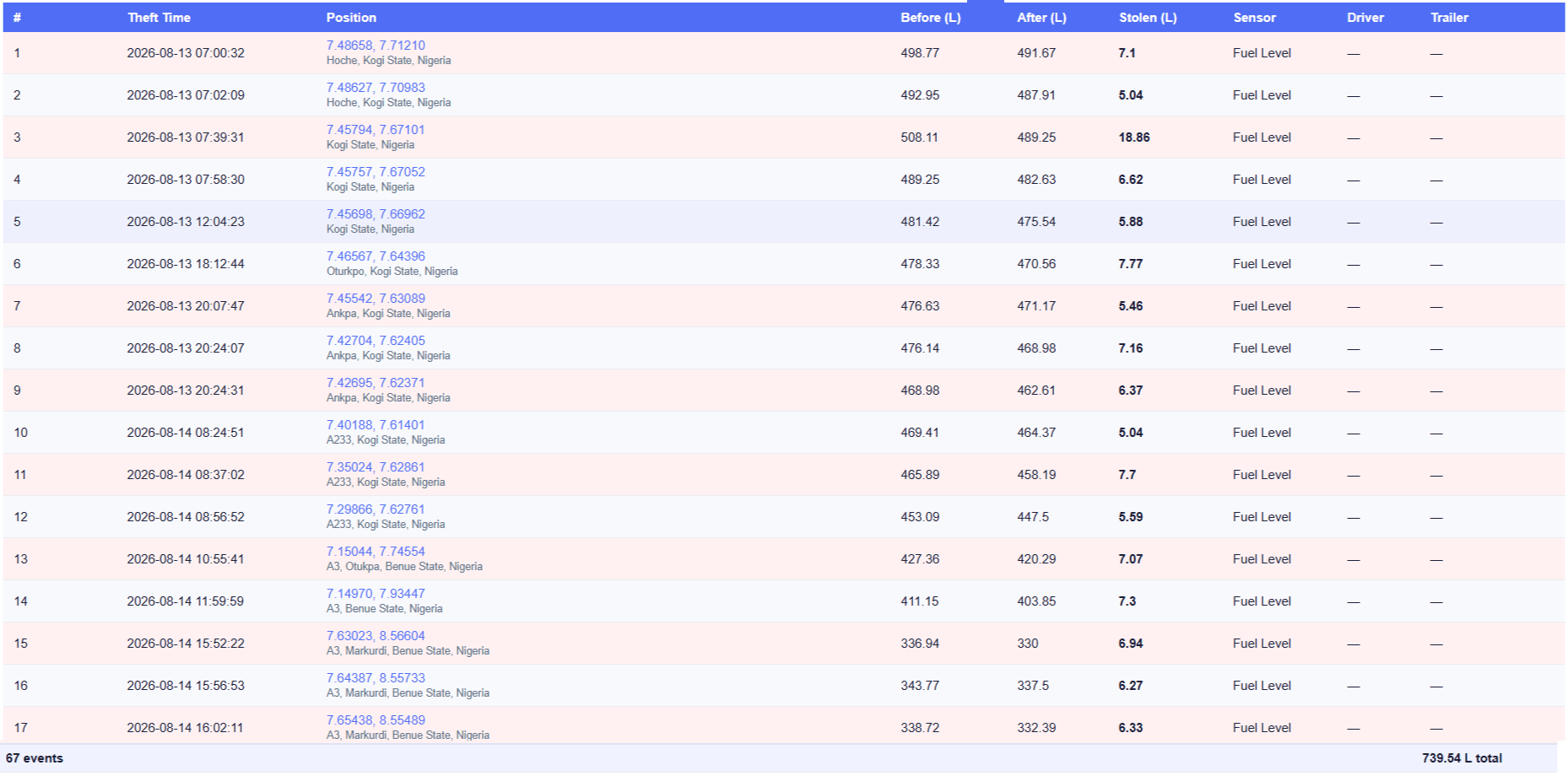
One evening this year, on a highway in north-central Nigeria, the fuel sensor in one of our clients' trucks recorded 7.16 litres of diesel leaving the tank. Twenty-four seconds later, less than 50 metres further on, it recorded another 6.37 litres.
Neither event would have moved the needle on a dashboard gauge, and neither would ever appear on a fuel receipt. By the end of that week the same truck's log held 67 drain events and 739.54 litres of diesel, stamped at positions strung out along a single trunk road. There was no dramatic midnight raid. There was a steady drip: seven litres here, five there, eighteen once, logged one after another while the truck worked its route.
Now put a price on the drip. In May, the National Bureau of Statistics put the average retail price of diesel at ₦3,277.47 a litre, up 86.4% in a year. Prices have eased since, but at the end of October Dangote Refinery's gantry price still stood at ₦1,840 a litre. Even at that wholesale figure, before a kobo of retail margin, one truck's week of losses comes to about ₦1.36 million. Multiply by a fleet and by 52 weeks, and siphoning stops being a nuisance you grumble about. It becomes the line item that decides whether your haulage business made money this year.
Why the biggest trucks are the softest targets
Thieves go where the diesel is, and few vehicles on a Nigerian highway carry more of it in their own tanks than a long-haul tractor unit. Scania's current aluminium diesel tanks come in sizes from 165 litres up to 910 litres, and the manufacturer's own bodybuilder guidance deals routinely with chassis specified with fuel tanks on both sides. The Scania, MAN and Sinotruk HOWO prime movers that pull containers, cement and grain across the country are specified for range. Fill once, keep moving for days.
That range is exactly the attraction. A full side tank is a drum of saleable diesel bolted to the chassis at knee height, and it sits unguarded every time the truck stops: in a loading queue, at a roadside buka after dark, in a driver's compound before an early start.
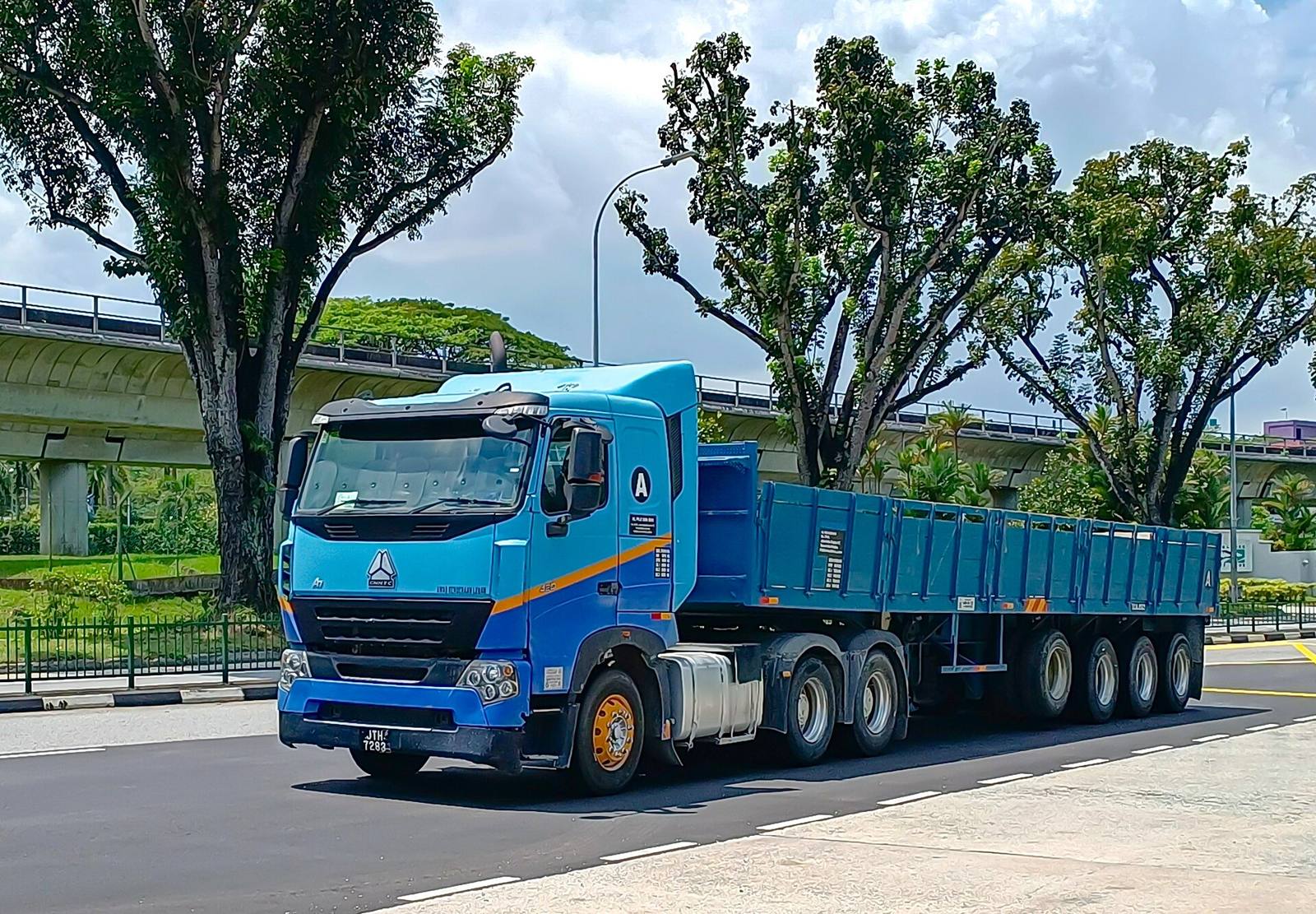
And Nigerian trucks spend a great deal of time standing still. In July, officials of the National Association of Road Transport Owners told Vanguard that hundreds of petroleum tankers regularly occupy the roads linking Apapa, Kirikiri, Coconut and Tin Can while they wait to load, with queues stretching for several kilometres. Every hour in a queue is an hour with the tanks exposed.
The cases that reach the newspapers tend to be the clumsy ones. In April 2024, Edo State police arrested three men over about 180 litres of diesel valued at ₦324,000, allegedly taken from a truck parked in front of a filling station on the Benin-Lagos Expressway in Benin City. In February 2026, Oyo State police said they had intercepted two suspects siphoning what they called "liquid substances suspected to be diesel" from a mixer truck at a construction site in Ibadan, and later recovered 24 barrels of about 240 litres each.
We could find no national figure for how much diesel is siphoned from vehicle tanks in Nigeria. Our suspicion is that this is not because the losses are small, but because most of them are never noticed, and so never reported.
The quiet arithmetic of small draws
Siphoning comes in two shapes. The first is the raid: tens or hundreds of litres taken in one sitting, usually at night, with the engine off and the truck parked somewhere quiet. It is crude, it is fast, and it leaves an obvious hole in the tank.
The second is the one that should worry you more, because it is designed to hide inside normal consumption. The 739.54-litre week is this kind. Its 67 events average about 11 litres each, and most of the rows visible in the extract below are between five and eight litres. Look at the positions and the timestamps: the events are spread along the route, minutes or hours apart, at different points on the A233 and the A3. Whoever was taking that diesel was betting that nobody would ever compare the litres burned with the kilometres covered, stop by stop. Without a sensor in the tank, nobody would have.
Small draws are not a smaller problem. They are a better-disguised one.
Small draws also corrupt everything else you measure. If 11 litres disappear at every other stop, the truck's fuel economy looks terrible, and you may end up blaming the engine, the tyres or the road for what is really a hose.
How a probe sees diesel
A capacitive fuel-level sensor is, at heart, a long capacitor lowered vertically into the tank. Two conductors run the height of the tank, and whatever fills the space between them, air or fuel, acts as the dielectric that sets the capacitance. Air has a dielectric constant of almost exactly 1; diesel's is about 2.1. As diesel rises up the probe it displaces air, and the capacitance climbs with it. A patent for one such sensor puts the logic plainly: as the liquid travels up the probe, the effective area of the capacitor's "fluent" plate "increases proportionally", and the electronics read that as a change in oscillator frequency.
The principle is well proven. Aircraft gauge their fuel with capacitance probes too, and aviation references describe the mechanism in one line: "Changes in fuel level cause a change in probe capacitance."
Three things decide whether the litres on your screen are true.
Calibration to your tank. Truck tanks are rarely neat boxes, so a given height of diesel does not equal the same number of litres at every level. A calibration table fixes that: measured volumes are poured into the tank in passes and the sensor reading is recorded each time. One telematics platform's documentation recommends passes of one-tenth to one-twentieth of the tank's volume, halved where the tank's shape changes. Skip this step and every figure downstream is a guess.
The liquid itself. Because capacitance depends directly on the dielectric constant, a sensor set up for one liquid will not read another correctly, a point the same patent makes explicitly. Aviation engineers note that probes "can be fooled by the density of the fuel". The sensor is tuned for diesel, and it should be calibrated with diesel.
The road. Fuel moves when the truck moves. Vendor documentation notes that vibrations from driving can affect fuel level readings, which is why a sound system smooths the signal before it decides anything has been stolen.
Two tanks, one truth
This is where many fuel-monitoring installations on heavy trucks quietly fall short. A tractor unit with a tank on each side of the chassis has two separate stores of diesel. Put a probe in only one, and you are watching half the truck. Anyone who knows which side is wired (and in a yard, people talk) simply drains the other.
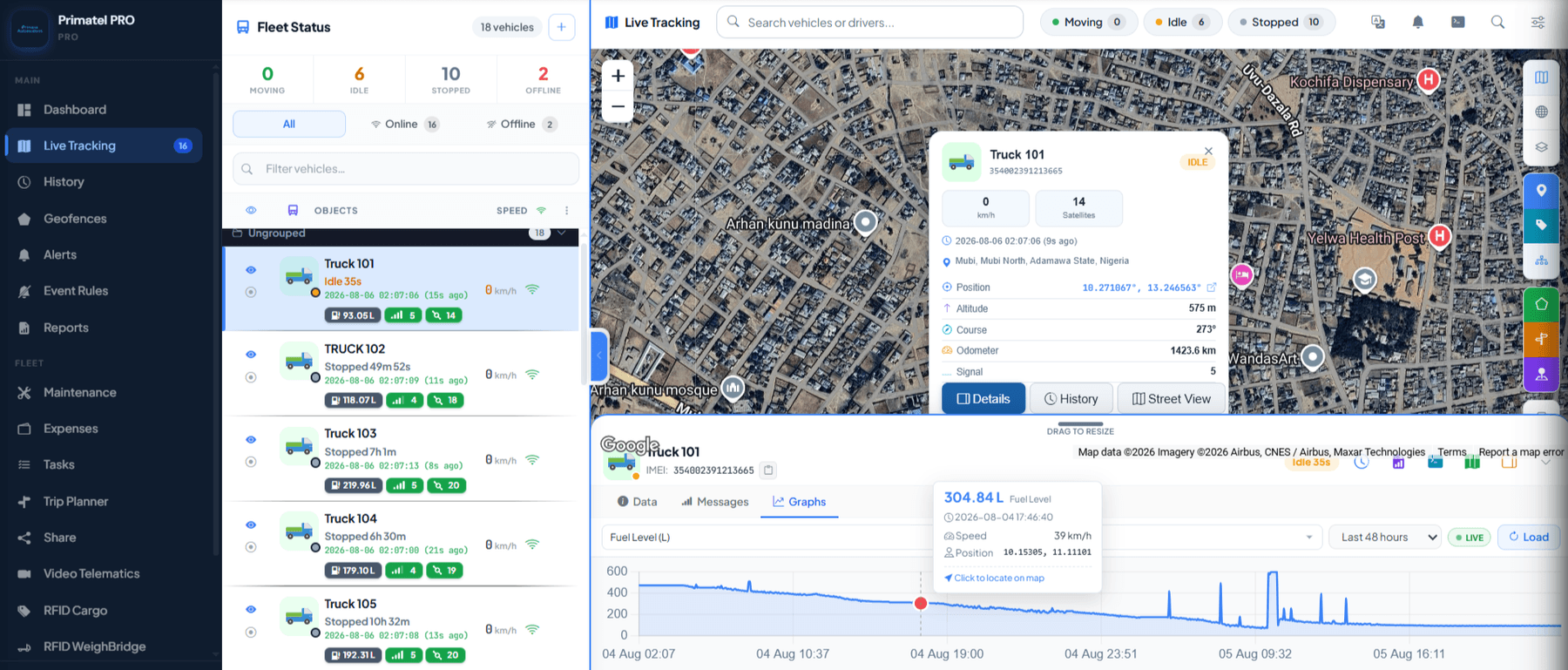
The fix is a probe in each tank, both reporting through the same tracker at the same moment, each with its own calibration table. The platform then does three jobs with the pair. It adds the two readings to give the truck's real total. It watches each tank on its own, so a sharp drop on one side is not averaged away by a steady level on the other. And it lines both up against the GPS, so every change carries a time and a place. That is how we fit fuel monitoring on Primera Fleet: a sensor in each tank, read alongside the GPS, with fills and drains listed automatically.
Read together, the two probes tell a story that one probe never could:
| What the probes show | Truck status | Most likely explanation | What to do |
|---|---|---|---|
| Combined level falls smoothly, in line with distance | Moving | Normal consumption | Nothing; it feeds your fuel-economy figures |
| One tank drops sharply, the other holds steady | Parked, ignition off | Siphoning from one side | Check the time and place against the trip; call the driver |
| One tank falls in a series of small steps, minutes apart | Moving or brief stops | Repeated small draws | Review the whole week's log, not just today |
| Both tanks rise within minutes | Stopped at a filling station | Refuel | Compare litres added with the receipt |
| Combined rise is smaller than the receipt claims | Stopped at a filling station | Short fill | Raise it with the station and the driver |
Parked or moving: telling theft from thirst
A parked truck with the ignition off should have a flat fuel line. Any fall is either a leak or a hose, and either way you want to know about it tonight, not at month-end.
A moving truck is harder, because the level is supposed to fall. The question becomes one of rate. In independent testing commissioned by the International Council on Clean Transportation, a typical European tractor-trailer used 32.6 litres per 100 km over a long-haul cycle. At 60 km/h, that is roughly a third of a litre a minute. Your own trucks, on Nigerian roads and with Nigerian loads, will burn more or less than that, so use your own figures; the point is the scale. A healthy engine on the move drinks a fraction of a litre a minute. The log in our opening shows 7.16 litres gone in one event and 6.37 in the next, 24 seconds apart. No engine burns diesel that fast.
So drain detection on a moving truck rests on two things: smoothing out the slosh, and comparing the speed of the fall with anything the engine could plausibly have consumed. When the fall is many times faster than any engine could manage, the system flags it with the litres, the time and the GPS position, so you are not left staring at a graph trying to spot a dip.
What a quiet week costs
Here is the 739.54-litre week priced three ways. The annual column assumes the same losses every week, which is exactly what happens when nobody is watching.
| Diesel price used | Source | One truck, one week (739.54 L) | Same truck, 52 weeks |
|---|---|---|---|
| ₦1,825 per litre | Lagos depot prices, 28 October 2026 | ₦1,349,660 | ₦70.2 million |
| ₦1,840 per litre | Dangote gantry price from 28 October 2026 | ₦1,360,754 | ₦70.8 million |
| ₦3,277.47 per litre | NBS average retail price, May 2026 | ₦2,423,820 | ₦126.0 million |
Depot and gantry prices are from Legit's 29 October market report; the retail average is the NBS Diesel Price Watch for May 2026. Your trucks may lose less. But it takes very few weeks like this to pay for a pair of sensors many times over, and one of our clients, a 120-vehicle logistics fleet in Lagos, cut its fuel losses by 35%.
When the alert lands: a protocol
An alert is the start of a conversation, not a verdict. Handle it the same way every time and your drivers will learn that the system is fair, which matters as much as catching anyone.
- Check the context within the hour. Open the drain on the map. Where was the truck, was the ignition on, and was it a scheduled stop?
- Rule out the innocent explanations. Was fuel legitimately transferred to a generator or another vehicle, with approval? Is there a fill or a workshop visit that explains it?
- Read the pattern, not the single event. One four-litre dip may be noise. Ten of them in a week at the same filling station or the same village is a pattern.
- Talk to the driver with the record in front of you. Times, places and litres turn an argument into a conversation about facts.
- Act consistently. A warning, a deduction, a route change or a police report is your decision. What matters is that the same evidence leads to the same response, whoever is driving.
- Close the gap that allowed it. Change the stop, the parking location, the fuelling arrangement or the person. Then watch the next week's log to see whether it worked.
What to do on Monday morning
- Count your tanks. List every truck and how many fuel tanks it actually has. If any are monitored on one side only, you have found your first leak.
- Ask for the calibration tables. Whoever fitted your sensors should be able to show you the table for each tank. No table, no trustworthy litres.
- Pull last month's drain report. Sort it by truck and by location. Look for the repeat offenders: the same truck, the same stop, the same time of night.
- Set a parked-drain alert. Any fall in fuel while the ignition is off should reach a named person immediately, not wait for a weekly review.
- Agree the response in advance. Write down what happens after a confirmed drain, and tell your drivers before the first alert fires.
- Price your losses honestly. Use this week's depot price, not last year's, when you work out what missing diesel is costing you.
The thief with a hose is betting on one thing: that nobody is reading the tank. Read both of them.
About Primera Automations
Primera Automations fits and calibrates capacitive fuel sensors in every tank of a truck, read alongside GPS so each fill and drain arrives with its time, place and litres. See how it works on our fuel intelligence page, or talk to us about your fleet.
Sources
- National Bureau of Statistics via Legit.ng, NBS: Diesel Price Rises 86.40% To N3,277/Litre In May 2026
- Legit.ng, Price War: Depot Owners Cut Diesel Prices Below Dangote's New Rate
- Scania, Next Level Modularity (brochure, PDF)
- Scania Bodybuilder, BBC Newsletter, November 2025 (PDF)
- Vanguard via AllAfrica, Oil Cartels, Tanker Operators, Enforcement Agencies Blamed for Apapa, Kirikiri Gridlock
- Daily Trust, Police arrest 3 for stealing 180 litres of diesel in Edo
- The Sun Nigeria, Two arrested over N12m diesel theft in Oyo
- The Engineering ToolBox, Liquids: Dielectric Constants
- Google Patents, US7963164B2: Capacitive sensor assembly for determining level of fluent materials
- Code7700, Fuel Capacitance Probes
- Navixy documentation (vendor), Fuel level sensor calibration (tare)
- Navixy documentation (vendor), Fuel sensor readings analysis and assessment
- International Council on Clean Transportation, Comparison of fuel consumption and emissions for representative heavy-duty vehicles in Europe (fact sheet, PDF)