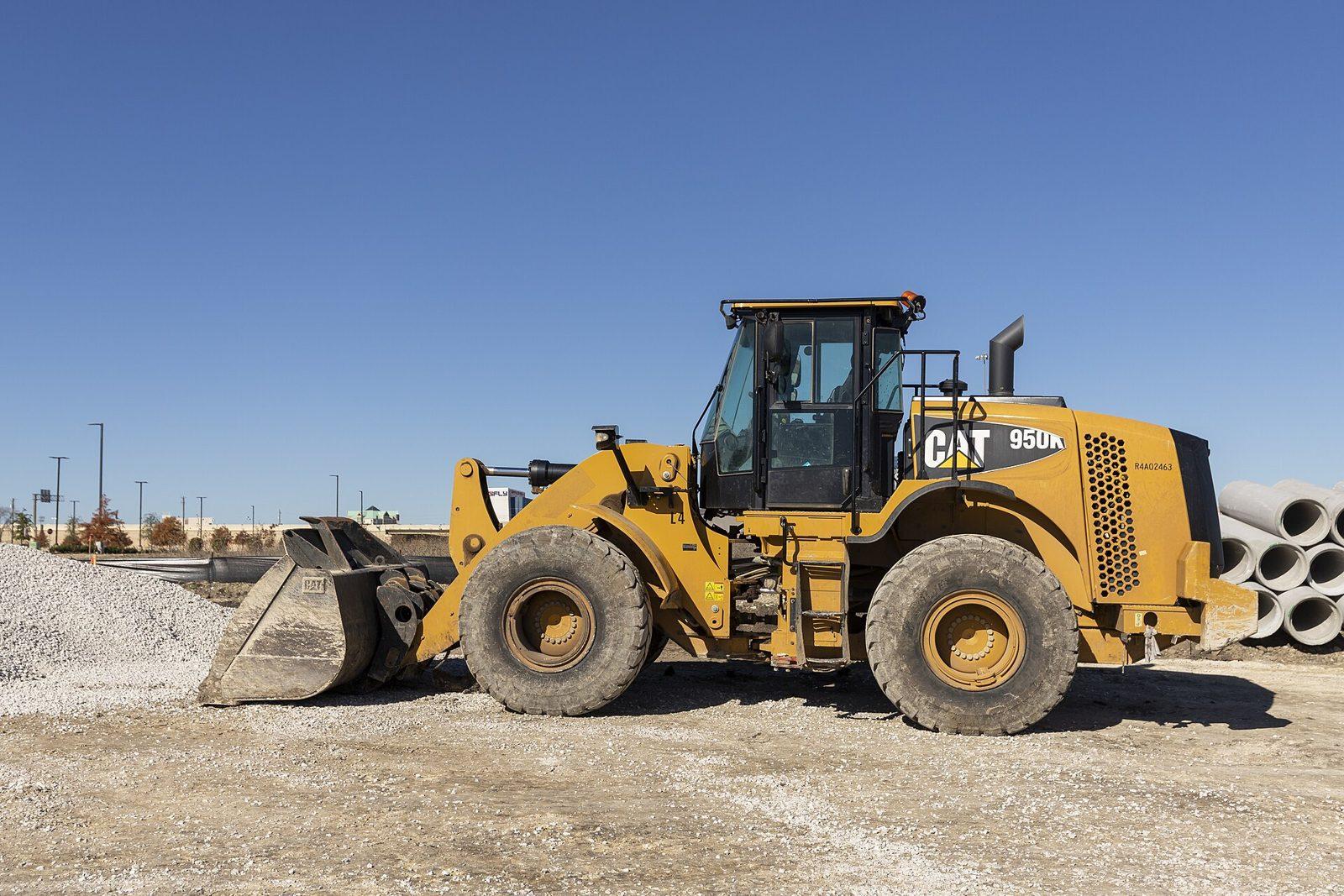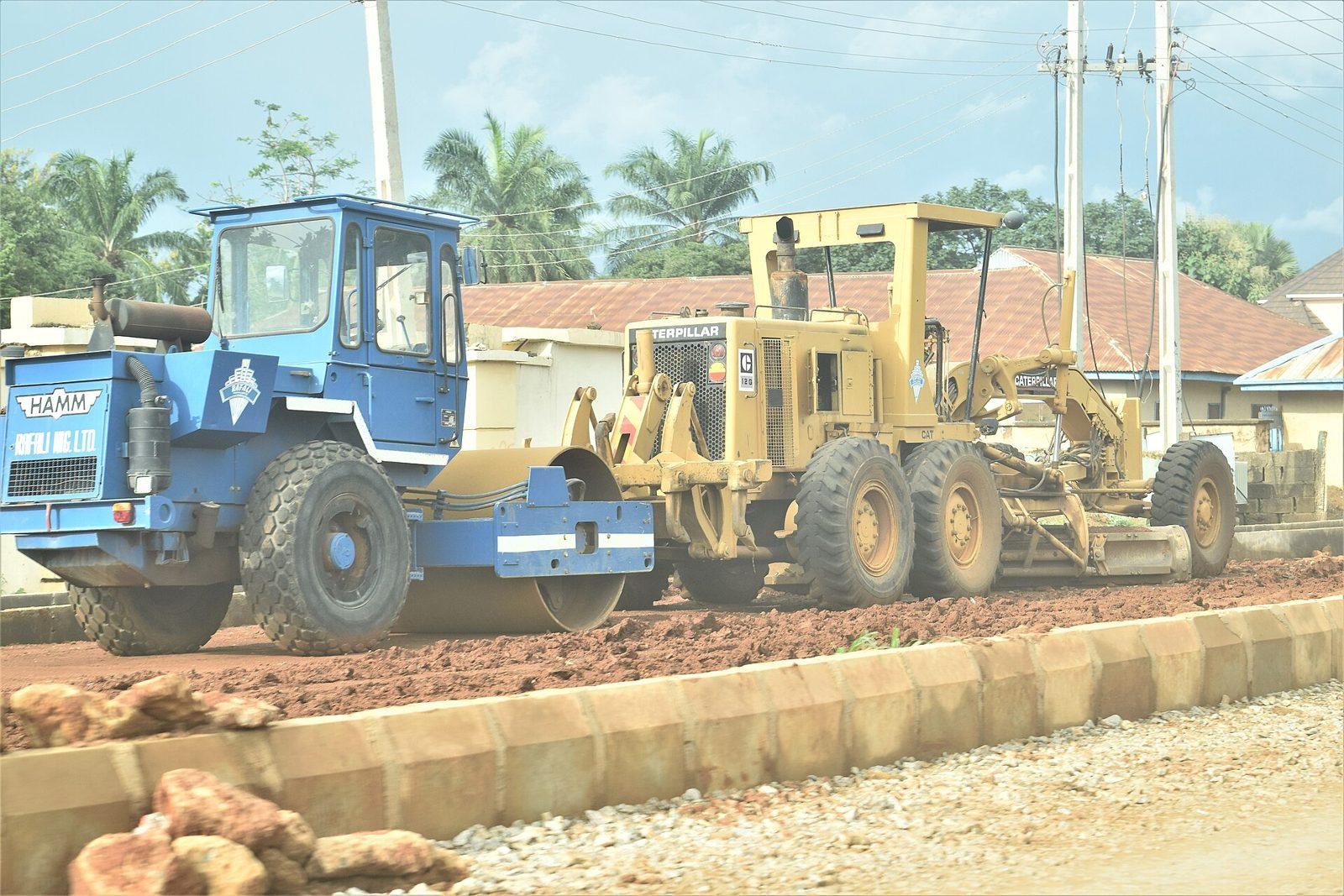
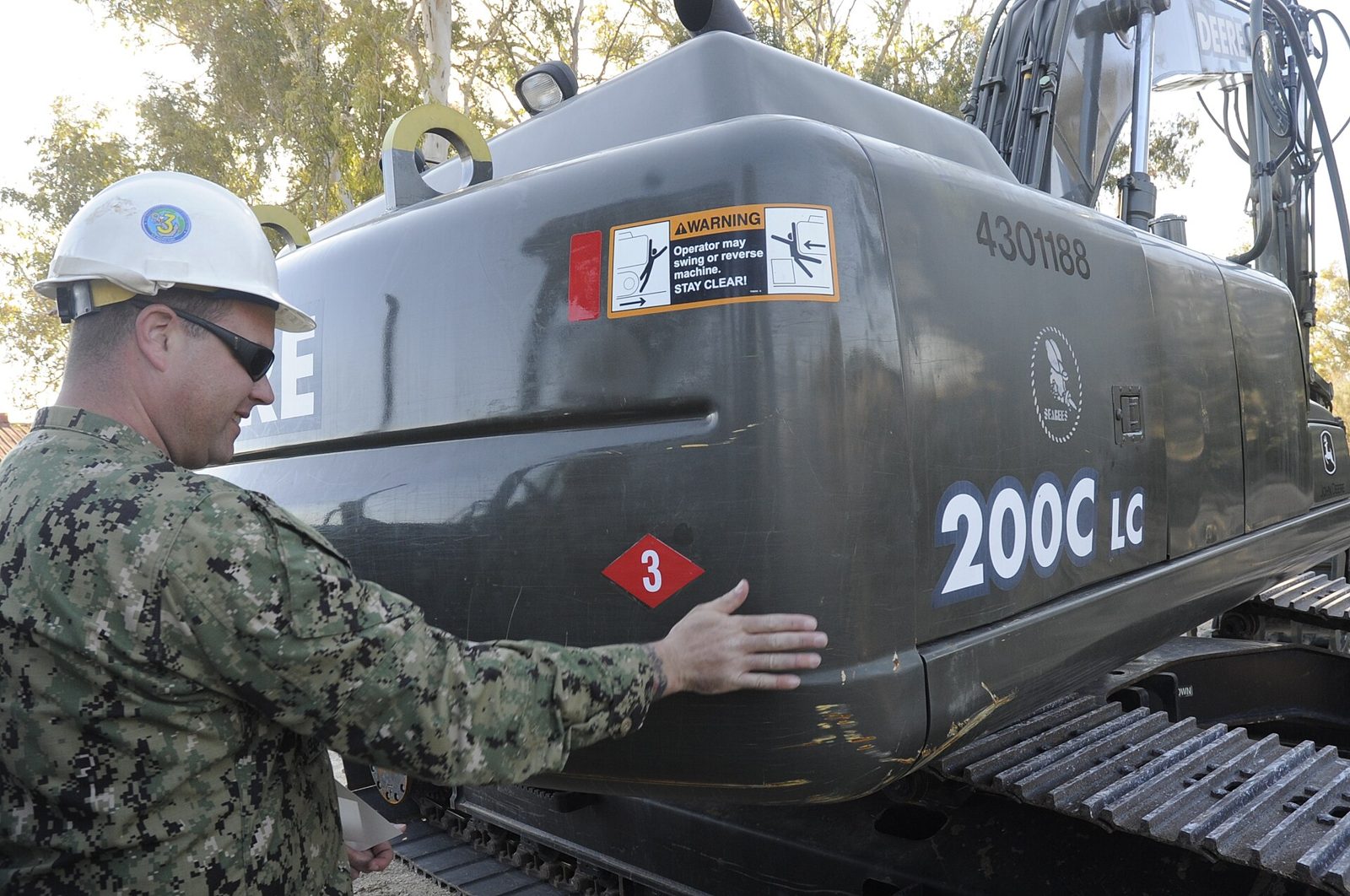
The sticker on the excavator's door says the next service is due in March. Someone wrote it in marker pen in December, after the last oil change, and added three months because that is what the yard always does.
Since then the machine has been on a drainage contract that runs two shifts a day. Nobody has looked at the hour meter, because nobody needed to: the sticker said March. When a fitter finally does look, the engine oil has done well over twice the hours it was meant to, the fuel filters are of the same vintage, and a pin on the bucket linkage that should have been greased every few days has been squealing for a week. The machine is still running. That is the dangerous part.
It is a composite scene, but most plant managers will recognise it. Calendar-based servicing is easy to run, and wrong for any machine whose workload changes. The manufacturers say so in their own manuals. Caterpillar's operation and maintenance manual for the 320D excavator tells the owner, in plain terms, to "use the service hour meter to determine servicing intervals". Calendar intervals may be used instead where they are more convenient and "approximate the indicated service hour meter reading".
For a Nigerian contractor this is not a technicality. A seized engine or a failed hydraulic pump stops a machine that may be the only one of its kind on site, and everything that depends on it stops with it: tippers, crew, the concrete gang waiting for a trench. This article explains how to build a maintenance schedule on engine hours, how automatic alerts take the guesswork out of it, and what a missed service really costs.
The machine already keeps its own diary
Every serious piece of earthmoving equipment has a service hour meter, and it is the most important instrument on the machine for maintenance. In the 320D manual, Caterpillar describes it as a display that "indicates the total operating hours of the engine", and says to use it to determine the service intervals.
Engine hours matter because they track wear. Oil breaks down with heat and combustion by-products, filters load up with what they catch, and pins and bushings wear with every cycle the machine makes. None of that happens while the machine sits in the yard with its engine off, and all of it happens faster on a double shift.
The calendar still has a job. Oil ages and condensation builds even in a machine that barely runs, which is why the manual's maintenance schedule says to use "mileage, fuel consumption, service hours, or calendar time, WHICH EVER OCCURS FIRST". The rule has two halves. Most yards only follow the half that is easy to write on a sticker.
What the manual actually asks for, hour by hour
It is worth seeing how much of a modern maintenance schedule is written in hours. These are selected items from Caterpillar's maintenance interval schedule for the 320D, an excavator of roughly 20 to 22 tonnes. Your machine's manual is the authority for your machine, but the shape is typical.
| Interval in the manual | Selected tasks |
|---|---|
| Every 10 service hours or daily | Check engine oil, coolant and hydraulic oil levels; drain the fuel water separator; inspect track adjustment |
| Every 50 service hours or weekly | Lubricate boom and stick linkage; inspect and adjust bucket linkage |
| Every 250 service hours (some items: or monthly) | Take engine oil and final drive oil samples; check final drive and swing drive oil levels; lubricate swing bearing |
| Every 500 service hours or 3 months | Change engine oil and filter; replace the fuel filters; clean the crankcase breather |
| Every 1,000 service hours or 6 months | Check engine valve lash; change swing drive oil; inspect the rollover protective structure (ROPS) |
| Every 2,000 service hours or 1 year | Change final drive oil; clean the hydraulic tank screen |
| Hydraulic oil change | 6,000 hours with the maker's premium hydraulic oil, otherwise 2,000 hours or 1 year |
Source: Caterpillar 320D Operation and Maintenance Manual, SEBU8053-20, maintenance interval schedule.
Two details in the same manual show why the hour meter on its own is not the whole story. First, the work matters as well as the hours. If the excavator runs a hydraulic hammer continuously, the hydraulic oil change comes up every 600 service hours of hammer use instead of the normal interval, and the hammer's oil filter is replaced every 100 hours of continuous hammer use. Second, the conditions matter. The manual warns that "under severe, dusty, or wet operating conditions" more frequent lubrication may be needed, and that if the fuel's sulphur content exceeds 1.5 per cent by weight, the engine oil change interval should be cut by half.
The manual is blunt about skipping any of it: "Failure to adhere to proper maintenance intervals and procedures may result in diminished performance of the product and/or accelerated wear of components."
Where the calendar goes wrong
Take three identical excavators on the same contract, each serviced on a calendar sticker every three months, and look at how many engine hours each one does between services.
| Machine | Workload (assumed) | Engine hours in 3 months | Against the 500-hour oil interval |
|---|---|---|---|
| A: double shift on a drainage job | 20 h a day, 26 days a month | about 1,560 | More than three times over |
| B: single shift, steady work | 10 h a day, 22 days a month | about 660 | About a third over |
| C: standing on a stalled site | 8 h a day, 10 days a month | about 240 | Under the hours; the 3-month limit applies |
Machine C is the one the calendar gets right, because when hours are low the manual's "whichever occurs first" rule hands the decision to the calendar. Machines A and B are the ones that earn you money, and they are exactly the ones the calendar under-services. Machine A should have had its oil changed at about four weeks. The sticker let it run for twelve.
There is a second trap hiding in those hours. A large share of engine hours on many sites is idling, and idle hours count on the meter just like digging hours. Leigh Dennis of the Sunrock Group told Construction Equipment magazine that when idling inflates the hours, "the owner incurs unnecessary preventive-maintenance costs". Servicing by the hour is right; cutting the idle hours is how you stop paying for services the machine did not earn.
What a missed service really costs
The oil and filters for a service are a known bill. The cost of not doing it arrives later, all at once, with a breakdown attached.
Mike Vorster, writing in Construction Equipment, sets out four ways to price downtime, using an eight-hour stoppage. At the cautious end, downtime costs only the machine's owning cost: $25 an hour, or $200 for the day. If you hire in a replacement at $100 an hour, it is $800. If the machine's whole team (trucks, crew, the work waiting behind it) stands idle with it, the bill in his example reaches $350 an hour, or $2,800. His simplest advice is to count the breakdowns themselves: "Simply put, if we do not have down events, we do not have downtime costs."
Here is the same logic with naira assumptions. These are illustrative figures, not market rates; put your own in.
| Method (after Vorster) | Assumed cost per hour | Cost of one 8-hour stoppage |
|---|---|---|
| Owning cost of the excavator only | ₦25,000 | ₦200,000 |
| Hiring in a replacement excavator | ₦40,000 | ₦320,000 |
| Excavator plus three tippers and crew standing | ₦175,000 | ₦1,400,000 |
And that is for a day. A failed engine or hydraulic pump does not come back in a day, particularly if the part has to be ordered. The extreme end of the scale comes from mining, where a Cat dealer's monitoring caught a failing high-pressure pump on a haul truck early: the planned repair cost about $75,000, and Construction Equipment reported that "an unscheduled repair would have cost 13 times more". Your machines are smaller. The ratio between planned and unplanned is the part that travels.
An oil change you schedule costs an oil change. An oil change you forget costs whatever breaks next, on the day it chooses.
How hour-based alerts actually work
The weakness of the hour meter is that it lives in the cab. Someone has to climb up, read it, write it down and compare it with the service plan, for every machine on every site. On a spread of fifteen machines across three states, that rarely happens every day.
Telematics moves the hour meter to your screen. The mechanics are straightforward:
- The tracker counts engine hours. It does this from an engine-running signal, or, on newer machines, by reading the engine's own figure from the data bus. SAE J1939, the network standard used on construction machines, cranes and mining equipment, includes a standard message for "Engine Total Hours of Operation".
- Each machine gets its service plan. You enter the intervals from its manual (500 hours for engine oil and filters, 1,000 for valve lash and ROPS inspection, and so on) together with the calendar limit.
- The platform raises the flag. When a machine approaches its interval it shows as due soon; when it passes it, overdue. The alert reaches the site engineer or the workshop without anyone visiting the cab.
- The service is recorded and the clock restarts. The next interval counts from the hours at which the work was actually done, not the hours at which it was planned.
In Primera Fleet, maintenance reminders can run from mileage or from engine data, and the 30-day dashboard has a maintenance panel listing what is overdue and what is due soon, per vehicle. Each machine's detail screen shows engine hours next to the odometer, which for plant is the number that matters.
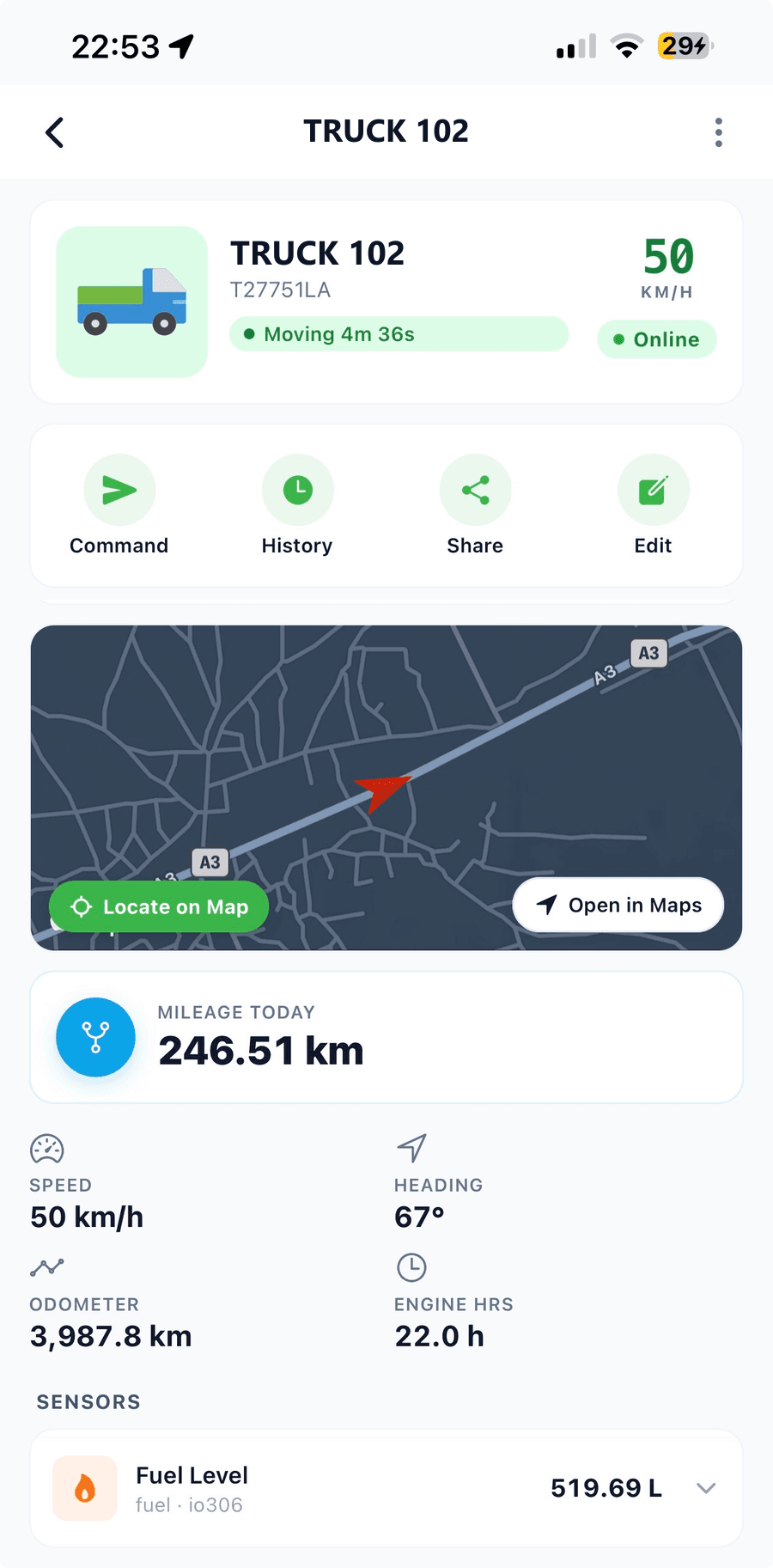
One practical warning. When a tracker is fitted to a machine that already has 6,000 hours on it, the platform's engine-hour count has to be set to match the cab meter on the day of installation, and checked against it now and then. Ask your installer to do this and to show you the two numbers side by side.
Structural checks belong on the schedule too
Oil and filters get the attention, but the failures that hurt people are often structural. The 320D manual requires a daily inspection of the operator guards for "structures that are bent, cracked or loose", and is unequivocal: "Never operate a machine with a damaged structure." The ROPS inspection (bolts, torque, cracks) sits at every 1,000 service hours or six months, and the bucket linkage is inspected and adjusted every 50 hours.
Those hour-based inspections are as easy to automate as an oil change. Put the 1,000-hour structural inspection on the same alert plan, and the daily walk-round becomes the operator's job while the hour-based inspection becomes the workshop's. Machines that do heavier work, such as hammering, deserve shorter intervals for the hydraulics. If you can measure hammer or other hydraulic work separately from engine hours, which needs a dedicated work signal and is not standard on most trackers, you can set those intervals properly too.
A protocol for site engineers
- List every machine with its make, model, serial number and current hour-meter reading. Photograph each meter.
- Get the right manual for each serial number and copy its maintenance interval schedule into one sheet per machine.
- Mark the work and conditions that shorten intervals: hammer use, dusty or wet sites, fuel quality.
- Fit or confirm engine-hour tracking on every machine, and check it against the cab meter.
- Load the intervals as automatic reminders with a "due soon" warning early enough to order parts and book a fitter.
- Record every service against the hours at which it was done, so the next interval counts from reality.
- Review overdue items weekly with the workshop, machine by machine, and log every breakdown as a down event so you can see the trend.
What to do on Monday morning
- Walk the yard and read the meters. Compare each machine's hours with its last service. The worst offender is usually the busiest machine.
- Throw away the door stickers that only carry a date. If you keep a sticker, put the next service hours on it as well.
- Find the manual for your three most important machines and pull out the 250, 500 and 1,000-hour lists.
- Ask the workshop for last year's breakdowns and count them. That number is your baseline.
- Get engine hours off the cab and onto a screen. Talk to us about tracking engine hours across your plant and setting reminders from them.
The machine has been keeping count all along. Your maintenance plan only has to start reading it.
About Primera Automations
Primera Automations installs and supports fleet telematics for construction, transport and logistics operators across 26+ Nigerian states, from offices in Lagos, Abuja, Warri, Asaba and Aba. The Primera Fleet platform tracks engine data and utilisation, sets maintenance reminders from mileage or engine data, and shows what is overdue and due soon on one dashboard. Talk to our engineers about your plant.
Sources
- Caterpillar, Operation and Maintenance Manual, 320D Excavator (SEBU8053-20)
- Construction Equipment (Mike Vorster), The Cost of Downtime
- Construction Equipment (Sean M. Gladieux), Telematics in Predictive Maintenance
- Construction Equipment (Walt Moore), How to Manage Engine Idling for Efficiency
- CSS Electronics, J1939 Explained: A Simple Intro